


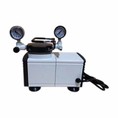
As a supplier of Oil-free Vacuum Pumps, I often encounter inquiries from customers about the vacuum degree stability of these pumps. In this blog post, I will delve into what vacuum degree stability means for an oil-free vacuum pump, its importance, factors affecting it, and how we ensure high - level stability in our products.
What is Vacuum Degree Stability?
Vacuum degree stability refers to the ability of a vacuum pump to maintain a relatively constant vacuum level over a certain period of time. In the context of an oil - free vacuum pump, it means that the pressure within the vacuum chamber created by the pump remains steady, with minimal fluctuations.
Let's understand this concept with a simple analogy. Imagine you are filling a container with water and trying to keep the water level constant. If the water level keeps rising and falling, it's difficult to perform any accurate operations that rely on a specific water level. Similarly, in industrial and laboratory applications, many processes require a stable vacuum environment. For instance, in semiconductor manufacturing, a stable vacuum is crucial for processes like chemical vapor deposition. Any instability in the vacuum degree can lead to inconsistent deposition rates, which may result in defective semiconductor chips.
Importance of Vacuum Degree Stability
The importance of vacuum degree stability cannot be overstated, especially in precision - oriented applications.
In the pharmaceutical industry, when conducting Microbial Limit Test Holder, a stable vacuum is essential. These tests are used to determine the number and types of microorganisms in pharmaceutical products. An unstable vacuum can cause inconsistent flow rates through the filtration system, leading to inaccurate test results. This can have serious consequences for product safety and regulatory compliance.


In research laboratories, where experiments often involve delicate chemical reactions or the study of microscopic particles, a stable vacuum is necessary for reliable data collection. Fluctuations in the vacuum degree can introduce variables into the experiment, making it difficult to draw accurate conclusions.
Factors Affecting Vacuum Degree Stability
Several factors can influence the vacuum degree stability of an oil - free vacuum pump.
Pump Design and Construction: The internal design of the pump plays a significant role. A well - designed pump with high - quality components is more likely to maintain a stable vacuum. For example, the precision of the pump's valves and seals is crucial. If the valves do not close tightly or the seals are leaky, air can enter the vacuum chamber, causing fluctuations in the vacuum degree.
Operating Conditions: The environment in which the pump operates can also affect stability. Temperature changes can cause the expansion or contraction of pump components, which may lead to changes in the vacuum level. High ambient temperatures can reduce the efficiency of the pump, resulting in less stable vacuum performance. Additionally, vibrations from nearby equipment can disrupt the smooth operation of the pump and cause vacuum instability.
Gas Load: The amount and type of gas being pumped can impact stability. If the gas load is too high, the pump may struggle to maintain a constant vacuum. Different gases also have different pumping characteristics. For example, some gases may be more difficult to pump than others, which can lead to variations in the vacuum degree.
How Our Oil - Free Vacuum Pumps Ensure Stability
At our company, we take several measures to ensure the high - level vacuum degree stability of our Oil - free Vacuum Pumps.
Advanced Design and Manufacturing: We use state - of - the - art design techniques and high - precision manufacturing processes. Our pumps are equipped with high - quality valves and seals that are carefully engineered to minimize leaks. The internal structure of the pump is optimized to ensure smooth gas flow and efficient pumping, reducing the likelihood of vacuum fluctuations.
Quality Control: We have a strict quality control system in place. Every pump undergoes rigorous testing before leaving the factory. We measure the vacuum degree stability under various operating conditions to ensure that it meets our high standards. This includes testing at different temperatures, gas loads, and for extended periods of time.
Monitoring and Feedback: Our pumps are designed with built - in sensors that can monitor the vacuum degree in real - time. If any fluctuations are detected, the pump can automatically adjust its operation to maintain stability. This feedback mechanism allows for quick responses to changes in operating conditions, ensuring a stable vacuum environment.
Applications of Our Stable Oil - Free Vacuum Pumps
Our oil - free vacuum pumps with high - level vacuum degree stability are suitable for a wide range of applications.
In the food industry, they are used for vacuum packaging. A stable vacuum ensures that the food products are properly sealed, extending their shelf life and maintaining their quality.
In the electronics industry, for the production of printed circuit boards (PCBs), a stable vacuum is required during the soldering process. Our pumps can provide the necessary stable vacuum environment to ensure high - quality soldering and reduce the occurrence of defects.
Conclusion
Vacuum degree stability is a critical factor in the performance of oil - free vacuum pumps. It is essential for a wide range of industries, from pharmaceuticals to electronics, to ensure accurate results, product quality, and process reliability. As a supplier of Oil - free Vacuum Pumps, we are committed to providing pumps with high - level vacuum degree stability. Our advanced design, strict quality control, and real - time monitoring capabilities ensure that our pumps can meet the demanding requirements of various applications.
If you are in need of an oil - free vacuum pump with excellent vacuum degree stability, we invite you to contact us for further discussions and to explore how our products can meet your specific needs. We look forward to the opportunity to work with you and provide you with the best vacuum solutions.
References
- "Vacuum Technology Handbook", edited by A. F. J. Levi
- "Principles of Vacuum Physics", by J. M. Lafferty
- Industry standards and guidelines related to vacuum pump performance and applications