


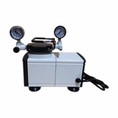
In the realm of scientific research, industrial production, and various laboratory applications, vacuum filtration systems play a pivotal role. As a dedicated supplier of vacuum filtration systems, I have witnessed firsthand the importance of understanding the relationship between vacuum degree and filtration speed. This blog post aims to delve into this intricate relationship, shedding light on how these two factors interact and influence the overall performance of a vacuum filtration system.
Understanding Vacuum Filtration
Before we explore the relationship between vacuum degree and filtration speed, let's briefly understand what vacuum filtration is. Vacuum filtration is a technique used to separate solids from liquids by applying a vacuum to the filtrate side of a filter. This creates a pressure difference across the filter medium, which forces the liquid through the filter while retaining the solid particles. The process is widely used in industries such as pharmaceuticals, food and beverage, chemical, and environmental science, as well as in research laboratories for sample preparation and analysis.
The Concept of Vacuum Degree
The vacuum degree refers to the level of pressure reduction below atmospheric pressure in a vacuum system. It is typically measured in units such as torr, millimeters of mercury (mmHg), or pascals (Pa). A higher vacuum degree means a lower pressure inside the system, which creates a greater pressure difference across the filter medium. This pressure difference is the driving force behind the filtration process, as it pushes the liquid through the filter more rapidly.
The Concept of Filtration Speed
Filtration speed, on the other hand, is the rate at which the liquid passes through the filter medium. It is usually expressed in units such as milliliters per minute (mL/min) or liters per hour (L/h). The filtration speed is influenced by several factors, including the properties of the filter medium (such as pore size, porosity, and thickness), the characteristics of the filtrate (such as viscosity and particle size), and the operating conditions of the vacuum filtration system (such as vacuum degree and temperature).
The Relationship between Vacuum Degree and Filtration Speed
The relationship between vacuum degree and filtration speed is generally positive, meaning that as the vacuum degree increases, the filtration speed also increases. This is because a higher vacuum degree creates a greater pressure difference across the filter medium, which provides a stronger driving force for the liquid to pass through the filter. However, this relationship is not always linear, and there are several factors that can affect the actual filtration speed at a given vacuum degree.
Factors Affecting the Relationship
- Filter Medium Properties: The properties of the filter medium can significantly affect the relationship between vacuum degree and filtration speed. For example, a filter with a smaller pore size will generally have a lower filtration speed at a given vacuum degree compared to a filter with a larger pore size. This is because the smaller pores create more resistance to the flow of the liquid, requiring a higher pressure difference to achieve the same filtration speed.
- Filtrate Characteristics: The characteristics of the filtrate, such as viscosity and particle size, can also influence the relationship between vacuum degree and filtration speed. A more viscous filtrate will require a higher vacuum degree to achieve the same filtration speed as a less viscous filtrate. Similarly, a filtrate with larger particles may clog the filter more easily, reducing the filtration speed even at a high vacuum degree.
- System Design and Operation: The design and operation of the vacuum filtration system can also affect the relationship between vacuum degree and filtration speed. For example, a system with a larger filter area will generally have a higher filtration speed at a given vacuum degree compared to a system with a smaller filter area. Additionally, proper maintenance and cleaning of the system are essential to ensure optimal performance and prevent clogging of the filter.
Optimizing Vacuum Degree for Filtration Speed
To achieve the optimal filtration speed in a vacuum filtration system, it is important to carefully consider the factors mentioned above and select the appropriate vacuum degree. In general, a higher vacuum degree is desirable for faster filtration, but it is also important to avoid creating too high a vacuum, which can cause the filter to rupture or the filtrate to boil.
Here are some tips for optimizing the vacuum degree for filtration speed:
- Select the Right Filter Medium: Choose a filter medium with the appropriate pore size and porosity for the specific application. Consider the characteristics of the filtrate, such as particle size and viscosity, when selecting the filter medium.
- Monitor and Adjust the Vacuum Degree: Continuously monitor the vacuum degree during the filtration process and adjust it as needed to maintain the desired filtration speed. Use a vacuum gauge to accurately measure the vacuum degree and make adjustments using a vacuum regulator.
- Pre-Filter the Filtrate: If the filtrate contains a large amount of solid particles, pre-filtering the filtrate can help prevent clogging of the main filter and improve the filtration speed. Use a pre-filter with a larger pore size to remove the larger particles before passing the filtrate through the main filter.
- Maintain the System: Regularly clean and maintain the vacuum filtration system to ensure optimal performance. Replace the filter medium when it becomes clogged or damaged, and check the seals and connections for leaks.
Our Vacuum Filtration Systems
As a leading supplier of vacuum filtration systems, we offer a wide range of high-quality products to meet the diverse needs of our customers. Our Stainless Steel Three Branches Vacuum Filtration System is designed for efficient and reliable filtration, with three branches that allow for simultaneous filtration of multiple samples. The stainless steel construction ensures durability and corrosion resistance, making it suitable for a variety of applications.


Our Stainless Steel One Branch Vacuum Filtration System is a compact and cost-effective solution for single-sample filtration. It is easy to operate and maintain, and the stainless steel design provides long-lasting performance.
For applications requiring high-capacity filtration, our Glass Six Branches Vacuum Filtration System is an excellent choice. The glass construction allows for easy visualization of the filtration process, and the six branches provide increased throughput.
Conclusion
In conclusion, the relationship between vacuum degree and filtration speed in a vacuum filtration system is complex and influenced by several factors. While a higher vacuum degree generally leads to a faster filtration speed, it is important to consider the properties of the filter medium, the characteristics of the filtrate, and the design and operation of the system to achieve the optimal filtration speed. By carefully selecting the appropriate vacuum degree and following the tips mentioned above, you can ensure efficient and reliable filtration in your vacuum filtration system.
If you are interested in learning more about our vacuum filtration systems or have any questions about the relationship between vacuum degree and filtration speed, please feel free to contact us for a consultation. We are committed to providing our customers with the highest quality products and services to meet their specific needs.
References
- Perry, R. H., & Green, D. W. (Eds.). (2008). Perry's Chemical Engineers' Handbook (8th ed.). McGraw-Hill.
- Malamataris, S., & Tien, C. (2007). Filtration: Principles and Practices (2nd ed.). CRC Press.
- ASTM International. (2019). Standard Test Methods for Determining Filtration Performance of Membrane Filters. ASTM D4189 - 19.