


The performance of chromatography media is a critical factor in achieving accurate and efficient separation in various chromatographic techniques. Among the many parameters that can affect this performance, the column diameter plays a significant role. As a chromatography media supplier, I have witnessed firsthand how different column diameters can impact the separation process. In this blog post, I will delve into the influence of column diameter on the performance of chromatography media, exploring both the advantages and disadvantages associated with different sizes.

Flow Rate and Pressure
One of the most immediate effects of column diameter is on the flow rate and pressure within the chromatographic system. According to the Hagen - Poiseuille equation, the flow rate (Q) through a cylindrical column is proportional to the fourth power of the column radius (r) and the pressure difference (ΔP) across the column, and inversely proportional to the viscosity (η) of the mobile phase and the column length (L):
[Q=\frac{\pi r^{4}\Delta P}{8\eta L}]
A larger column diameter (i.e., larger r) allows for a higher flow rate at a given pressure. This can be advantageous when dealing with large - volume samples or when high - throughput analysis is required. For example, in preparative chromatography, where the goal is to isolate large quantities of a target compound, a larger column diameter can accommodate a higher flow rate, reducing the separation time and increasing the overall productivity.

However, increasing the column diameter also has its drawbacks. As the column diameter increases, the linear velocity of the mobile phase decreases for a given flow rate. This can lead to broader peaks and reduced separation efficiency, especially for analytes with poor diffusion coefficients. Additionally, larger columns require more mobile phase, which can be costly and environmentally unfriendly, especially in cases where expensive or hazardous solvents are used.
Sample Capacity
Column diameter also has a direct impact on the sample capacity of the chromatography media. The sample capacity is the maximum amount of sample that can be loaded onto the column without significantly affecting the separation efficiency. A larger column diameter provides a greater surface area for the interaction between the sample and the stationary phase, allowing for a higher sample loading.
In preparative chromatography, this increased sample capacity is crucial. For instance, when purifying natural products or synthesizing large - scale pharmaceuticals, a larger column can handle larger sample volumes, enabling the isolation of substantial amounts of the target compound. On the other hand, in analytical chromatography, where the focus is on detecting and quantifying trace amounts of analytes, a smaller column diameter may be more appropriate. Smaller columns have a lower sample capacity but offer higher sensitivity and better peak resolution for low - concentration samples.
Peak Resolution
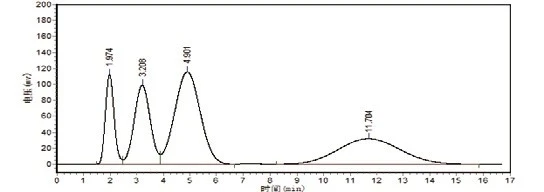
Peak resolution is a measure of how well two adjacent peaks are separated in a chromatogram. It is affected by several factors, including column diameter. In general, smaller column diameters tend to provide better peak resolution. This is because the diffusion of analytes within the column is more restricted in a narrow column, resulting in sharper peaks.
The reduced peak width in a narrow column can be attributed to the shorter path length for radial diffusion of the analytes. As the analytes travel through the column, they are less likely to spread out radially, leading to better separation between different components of the sample. However, it is important to note that achieving high resolution in a narrow - diameter column often requires more precise control of experimental conditions, such as flow rate and temperature.
Scale - up Considerations
When scaling up a chromatography process from analytical to preparative scale, column diameter becomes a crucial parameter. The transition from a small - diameter analytical column to a larger - diameter preparative column must be carefully planned to maintain the separation performance.
One of the key challenges in scale - up is maintaining the same linear velocity of the mobile phase. Since the flow rate is proportional to the square of the column diameter, a significant increase in column diameter requires a corresponding increase in flow rate to keep the linear velocity constant. Failure to maintain the appropriate linear velocity can lead to changes in peak shape and separation efficiency.

Different Chromatography Media and Column Diameter
At our company, we offer a variety of chromatography media, each with its own characteristics and suitability for different column diameters. For example, Silica Based Spherical media is known for its high mechanical stability and uniform particle size, making it suitable for both small - and large - diameter columns. These spherical particles pack well in the column, providing a consistent flow path for the mobile phase and good separation performance.
Silica Based Amorphous Packing media, on the other hand, has a more irregular particle shape. It can be a cost - effective option for larger - diameter columns, especially in preparative applications where high sample capacity is required. However, the irregular shape may lead to slightly lower separation efficiency compared to spherical media, especially in narrow - diameter columns.
Silica Gel 60 is a widely used chromatography media with a well - defined pore size. It can be used in columns of different diameters, depending on the specific separation requirements. In small - diameter columns, it can provide high - resolution separations for analytical applications, while in larger columns, it can handle larger sample loads for preparative work.
Conclusion
In conclusion, the column diameter has a profound influence on the performance of chromatography media. It affects flow rate, pressure, sample capacity, peak resolution, and scale - up considerations. When choosing a column diameter, it is essential to consider the specific requirements of the separation, such as the type of sample, the desired throughput, and the level of resolution needed.
As a chromatography media supplier, we understand the importance of providing the right products for different applications. Our range of chromatography media, including Silica Based Spherical, Silica Based Amorphous Packing, and Silica Gel 60, is designed to meet the diverse needs of our customers. Whether you are conducting analytical research or large - scale preparative work, we can help you select the appropriate chromatography media and column diameter for optimal performance.
If you are interested in learning more about our chromatography media or have specific requirements for your separation process, we encourage you to contact us for procurement and further discussion. We are committed to providing high - quality products and excellent customer service to support your chromatography needs.
References
- Snyder, L. R., Kirkland, J. J., & Glajch, J. L. (1997). Practical HPLC Method Development. John Wiley & Sons.
- Neue, U. D. (1997). HPLC Columns: Theory, Technology, and Practice. John Wiley & Sons.
- Poole, C. F., & Poole, S. K. (2003). Chromatography Today. Elsevier.