


Hey there! Today, I'm gonna talk about the difference between a gravity filtration and a vacuum filtration system. As a supplier of vacuum filtration systems, I've got a pretty good handle on both, and I'm excited to share this knowledge with you.
Let's start with gravity filtration. It's one of the oldest and simplest methods of separating solids from liquids. You've probably seen it in a high - school science class. All you need is a filter paper, a funnel, and a container to collect the filtrate. The way it works is pretty straightforward. You pour the mixture of solid and liquid onto the filter paper in the funnel. Gravity does the rest, pulling the liquid through the tiny pores of the filter paper while the solid particles get trapped on the paper.
One of the big advantages of gravity filtration is its simplicity. You don't need any fancy equipment, just a few basic lab supplies. It's also a very gentle method, which means it's great for delicate substances that might be damaged by more aggressive filtration techniques. For example, if you're filtering a biological sample that contains living cells, gravity filtration can help ensure that the cells remain intact.
However, gravity filtration has its drawbacks. The biggest one is speed. Since it relies solely on gravity to pull the liquid through the filter, it can be a very slow process, especially if you're dealing with a large volume of liquid or a thick mixture. Imagine having to wait hours for a large batch of a viscous solution to filter through. It's not very efficient, right?
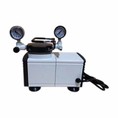
Now, let's switch gears and talk about vacuum filtration systems. As the name suggests, these systems use a vacuum to speed up the filtration process. Instead of relying on gravity alone, a vacuum creates a pressure difference that sucks the liquid through the filter paper much faster.
In a vacuum filtration system, you typically have a filtration flask, a Buchner funnel, and a vacuum source. The filter paper is placed in the Buchner funnel, and the funnel is connected to the filtration flask. The vacuum source is then attached to the flask, creating a negative pressure inside. When you pour the mixture onto the filter paper, the vacuum pulls the liquid through the paper and into the flask in a matter of minutes, sometimes even seconds.
One of the main advantages of vacuum filtration systems is speed. They can filter large volumes of liquid in a fraction of the time it would take with gravity filtration. This makes them ideal for high - throughput applications, such as in industrial laboratories or large - scale production facilities. For example, in a pharmaceutical manufacturing plant, vacuum filtration can quickly separate the active ingredients from the reaction mixture, saving time and increasing productivity.
Another benefit of vacuum filtration systems is their versatility. They can handle a wide range of substances, from thin liquids to thick slurries. The increased pressure from the vacuum can force even the most viscous materials through the filter, making it a great choice for difficult filtration tasks.
But vacuum filtration systems aren't without their downsides. They require more equipment and a power source for the vacuum pump, which means they're more expensive and complex to set up compared to gravity filtration. Also, the higher pressure can sometimes cause problems with delicate samples. If the vacuum is too strong, it can damage the solid particles or the filter paper itself.
Now, I'd like to introduce some of the vacuum filtration systems we offer. We have the Glass Six Branches Vacuum Filtration System. This system is made of high - quality glass, which is resistant to many chemicals. The six branches allow you to perform multiple filtrations simultaneously, increasing efficiency. It's a great choice for laboratories that need to process multiple samples at once.


If you're looking for something a bit more compact, we have the Stainless Steel Three Branches Vacuum Filtration System. The stainless - steel construction makes it durable and suitable for harsh environments. The three branches still give you the ability to filter multiple samples at the same time, but in a more space - efficient design.
For smaller - scale applications, we offer the Glass One Branch Vacuum Filtration System. This simple yet effective system is perfect for individual experiments or small - volume filtrations.
So, which filtration method should you choose? Well, it depends on your specific needs. If you're working with a small volume of a delicate substance and have plenty of time, gravity filtration might be the way to go. But if you need to filter large volumes quickly or deal with difficult - to - filter materials, a vacuum filtration system is definitely worth considering.
If you're interested in learning more about our vacuum filtration systems or have any questions about choosing the right filtration method for your application, don't hesitate to reach out. We're here to help you make the best decision for your laboratory or production facility. Whether you're a researcher in a university lab or a quality control technician in a manufacturing plant, we've got the filtration solutions you need.
In conclusion, understanding the differences between gravity filtration and vacuum filtration systems is crucial for anyone involved in filtration processes. Each method has its own advantages and disadvantages, and choosing the right one can save you time, money, and headaches in the long run.
References
- Harris, D. C. (2015). Quantitative Chemical Analysis. W. H. Freeman and Company.
- Skoog, D. A., West, D. M., Holler, F. J., & Crouch, S. R. (2013). Fundamentals of Analytical Chemistry. Cengage Learning.