


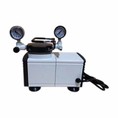
Vacuum filtration is a widely used technique in various industries, including chemistry, biology, pharmaceuticals, and environmental science. It offers a fast and efficient way to separate solids from liquids by using a vacuum to draw the liquid through a filter medium. As a leading supplier of vacuum filtration systems, I'm here to delve into the main components that make up these systems and how they work together to achieve optimal filtration results.
1. Filtration Flask
The filtration flask is a key component of the vacuum filtration system. It is typically made of glass or plastic and is designed to collect the filtrate, the liquid that passes through the filter. Glass flasks are preferred in many laboratory settings due to their chemical resistance and transparency, which allows for easy observation of the filtration process. The flask has a sidearm that is connected to the vacuum source to create the negative pressure needed for filtration.
In our product range, we offer high - quality filtration flasks that are designed to withstand the rigors of vacuum filtration. They come in various sizes to meet different filtration requirements, whether you are working on a small - scale laboratory experiment or a large - scale industrial process.
2. Filter Funnel
The filter funnel is placed on top of the filtration flask and holds the filter paper or other filter media. There are different types of filter funnels available, such as Buchner funnels and Hirsch funnels. Buchner funnels are larger and more commonly used for larger - volume filtrations, while Hirsch funnels are smaller and suitable for smaller - scale operations.
The filter funnel is designed to distribute the liquid evenly over the filter medium, ensuring efficient filtration. It has a perforated plate or a fritted disc at the bottom to support the filter paper and allow the liquid to pass through. Our filter funnels are made from high - quality materials, ensuring long - term durability and excellent filtration performance.
3. Filter Media
Filter media play a crucial role in vacuum filtration as they are responsible for separating the solids from the liquid. The choice of filter media depends on the nature of the sample, the size of the particles to be filtered, and the required purity of the filtrate.


Common types of filter media include filter paper, membrane filters, and sintered glass filters. Filter paper is a widely used and cost - effective option for general filtration. It comes in different pore sizes to accommodate different particle sizes. Membrane filters, on the other hand, offer precise control over the pore size and are suitable for applications where high - purity filtrates are required. Sintered glass filters are made by fusing glass particles together and are known for their high chemical resistance and mechanical strength.
We offer a wide range of filter media to meet the diverse needs of our customers. Whether you need standard filter paper or specialized membrane filters, we have the right solution for your filtration requirements.
4. Vacuum Source
A reliable vacuum source is essential for the proper functioning of a vacuum filtration system. The vacuum source creates the negative pressure that draws the liquid through the filter medium. There are several types of vacuum sources available, including vacuum pumps, aspirators, and vacuum manifolds.
Vacuum pumps are the most common choice for laboratory and industrial applications. They can provide a strong and consistent vacuum and are available in different types, such as rotary vane pumps, diaphragm pumps, and scroll pumps. Aspirators are a more cost - effective option and are often used in educational settings. They work by using the flow of water to create a vacuum. Vacuum manifolds are used to connect multiple filtration setups to a single vacuum source, allowing for parallel filtration.
As a supplier, we offer a variety of vacuum sources to suit different budgets and applications. Our vacuum pumps are known for their high performance, reliability, and low maintenance requirements.
5. Tubing and Connectors
Tubing and connectors are used to connect the different components of the vacuum filtration system, such as the filtration flask, filter funnel, and vacuum source. They need to be airtight to ensure the proper functioning of the vacuum. The tubing is usually made of rubber or silicone, which are flexible and resistant to chemicals.
Connectors come in different shapes and sizes to fit the various components. They ensure a secure and leak - free connection between the tubing and the components. We provide high - quality tubing and connectors that are compatible with our vacuum filtration systems, ensuring a seamless and efficient setup.
6. Manifolds (Optional but Useful)
Manifolds are an optional but highly useful component in a vacuum filtration system, especially when multiple filtrations need to be performed simultaneously. They allow for the connection of multiple filtration flasks to a single vacuum source, improving efficiency and reducing the time required for filtration.
We offer different types of manifolds, such as the Glass One Branch Vacuum Filtration System, the Stainless Steel Three Branches Vacuum Filtration System, and the Stainless Steel Six Branches Vacuum Filtration System. These manifolds are made from high - quality materials, ensuring durability and reliable performance.
Conclusion
In conclusion, a vacuum filtration system consists of several key components, including the filtration flask, filter funnel, filter media, vacuum source, tubing and connectors, and optionally, manifolds. Each component plays a crucial role in the overall performance of the system, and choosing the right components is essential for achieving efficient and effective filtration.
As a leading supplier of vacuum filtration systems, we are committed to providing high - quality products that meet the needs of our customers. Whether you are a researcher in a laboratory or an engineer in an industrial setting, we have the right solutions for your vacuum filtration requirements.
If you are interested in learning more about our vacuum filtration systems or would like to discuss your specific filtration needs, please feel free to contact us. Our team of experts is ready to assist you in selecting the most suitable components for your application and provide you with excellent support throughout the purchasing process.
References
- Pavia, D. L., Lampman, G. M., Kriz, G. S., & Engel, R. G. (2016). Introduction to Organic Laboratory Techniques: A Small-Scale Approach. Cengage Learning.
- Harris, D. C. (2016). Quantitative Chemical Analysis. W. H. Freeman.
- Skoog, D. A., West, D. M., Hollyer, F. J., & Crouch, S. R. (2013). Fundamentals of Analytical Chemistry. Brooks/Cole.